
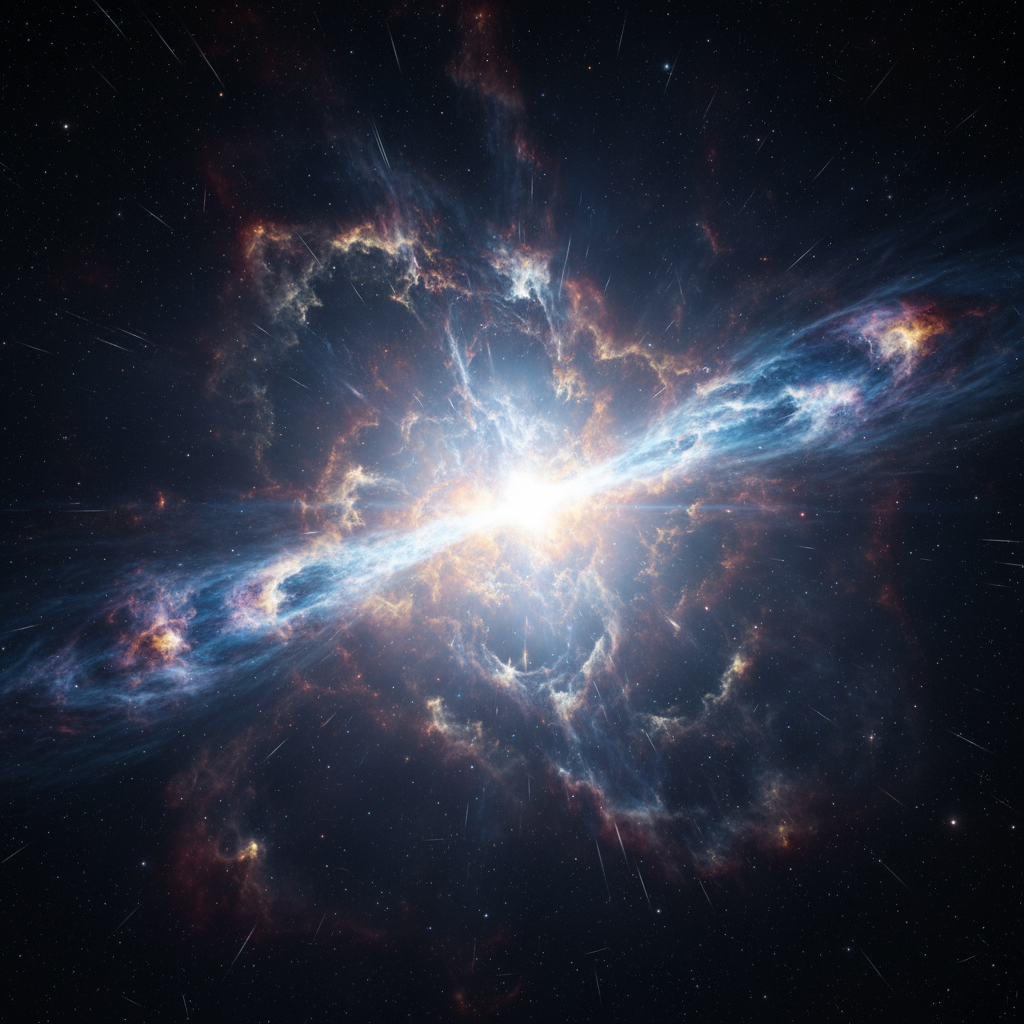

What is a Supernova? Understanding the Explosive Death of Stars
A supernova is the colossal explosion of a star. It is the largest explosion that takes place in space, capable of briefly outshining an entire galaxy and radiating as much energy in a few weeks as our Sun will emit over its entire 10-billion-year lifespan. These cataclysmic events mark the violent end of a massive star's life or a critical tipping point in a binary star system.
While they are destructive, supernovae are also the primary engines of creation in the cosmos. They are responsible for distributing the heavy elements—such as iron, carbon, and oxygen—that eventually form planets and life itself.
The Mechanisms: How Does a Supernova Occur?
Stars are engaged in a constant battle against their own gravity. The core of a star acts like a nuclear fusion reactor, converting hydrogen into helium and generating immense outward pressure. This pressure counteracts the inward pull of gravity, keeping the star stable. However, when a star runs out of fuel, the balance is lost, leading to one of two primary types of supernovae.
Type I Supernovae: Binary Systems
Type I supernovae, specifically Type Ia, occur in binary star systems where two stars orbit one another. In this scenario, one of the stars is a white dwarf—a dense remnant of a smaller star. The white dwarf steals matter from its companion star. Eventually, the white dwarf accumulates so much mass that it can no longer support its own structure. This triggers a runaway nuclear reaction, causing the star to explode.
Type II Supernovae: Core Collapse
Type II supernovae occur in single stars that are much more massive than our Sun (at least 8 to 15 solar masses). As the star consumes its fuel, it begins fusing heavier and heavier elements, eventually creating an iron core. Since fusing iron consumes energy rather than creating it, the outward pressure stops. Gravity instantly wins the battle, causing the core to collapse in a fraction of a second. The outer layers rush inward, bounce off the dense core, and explode outward into space.
Comparison: Type Ia vs. Type II Supernovae
To understand the distinct differences between these two celestial events, refer to the comparison table below.
| Feature | Type Ia Supernova | Type II Supernova |
|---|---|---|
| Progenitor | White Dwarf in a binary system | Massive Supergiant Star |
| Cause | Runaway nuclear reaction due to mass accretion | Core collapse due to fuel exhaustion |
| Spectrum | Lacks hydrogen lines | Contains hydrogen lines |
| Remnant | Usually nothing (complete destruction) | Neutron Star or Black Hole |
The Aftermath: What Remains?
The explosion of a supernova is not always the end of the story. Depending on the mass of the original star, the remaining core will transform into one of two incredibly dense objects:
Neutron Stars
If the collapsing core is between about 1.4 and 3 times the mass of the Sun, the protons and electrons are crushed together to form neutrons. The result is a neutron star—a city-sized sphere so dense that a teaspoon of its material would weigh a billion tons on Earth.
Black Holes
If the remnant core is more than 3 times the mass of the Sun, not even neutron degeneracy pressure can stop the collapse. The core continues to shrink until it becomes a singularity, forming a black hole, a region of space where gravity is so strong that nothing, not even light, can escape.
Why Are Supernovae Important?
Supernovae are essential to the chemical complexity of the universe. During the explosion, the intense heat and pressure synthesize elements heavier than iron, such as:
- Gold
- Silver
- Uranium
The explosion then acts as a cosmic delivery system, scattering these elements across the galaxy. These clouds of enriched dust and gas eventually coalesce to form new star systems.
Consequently, the atoms in your body—the calcium in your bones and the iron in your blood—were forged in the heart of a star that exploded billions of years ago. In a very literal sense, we are all made of stardust.
Sem comentários