

What Is the Milky Way?
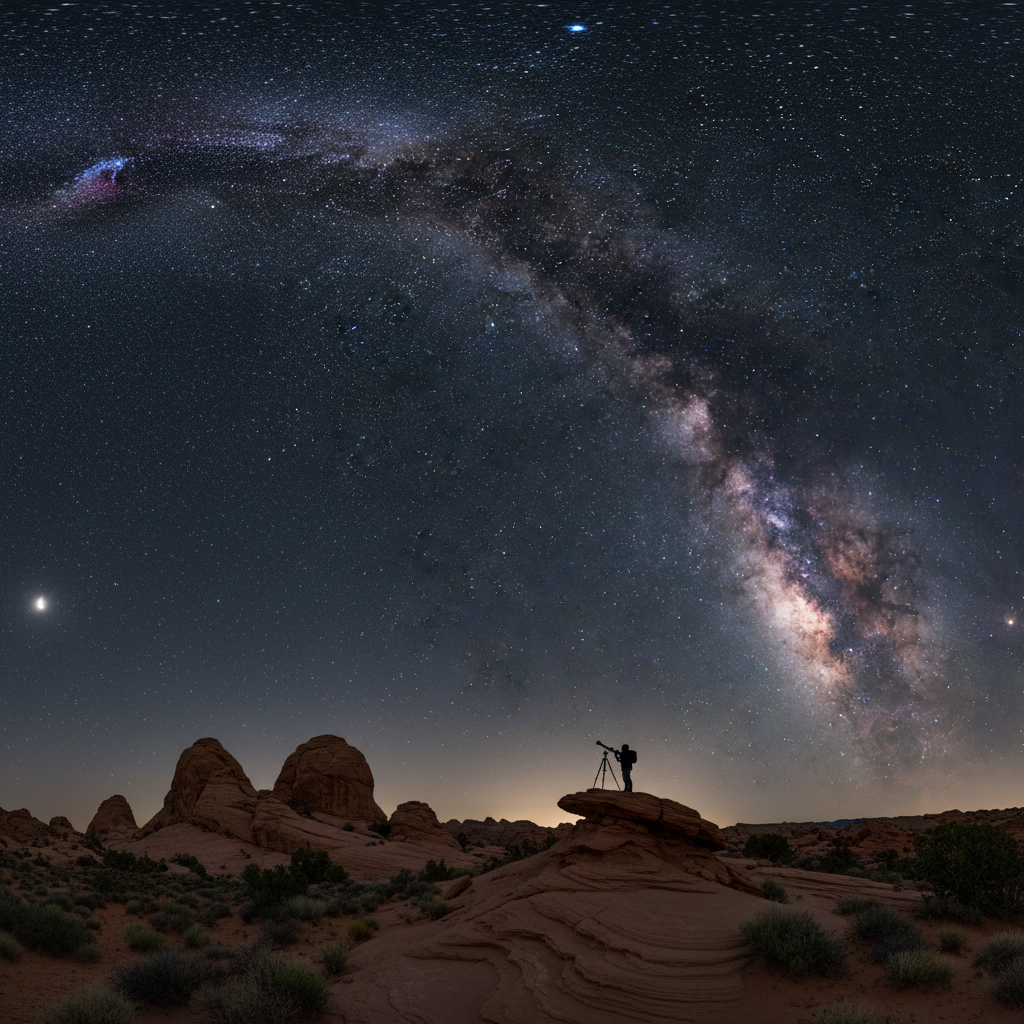
When we look up at the night sky in a remarkably dark location, we often see a faint, luminous band stretching across the heavens. This is the Milky Way, our home galaxy. From our vantage point on Earth, we view it edge-on, appearing as a cloudy strip of light. However, in the grand context of the cosmos, the Milky Way is a barred spiral galaxy of immense scale and complexity, containing hundreds of billions of stars, planets, gas, and dust.
Understanding the Milky Way is crucial to understanding our place in the universe. It is not merely a collection of stars but a gravitationally bound system that functions as a stellar nursery, a graveyard for ancient suns, and a laboratory for extreme physics. In this guide, we will explore the structure, composition, and mysteries of our galactic neighborhood.
The Structure and Composition of the Galaxy
The Milky Way is classified as a barred spiral galaxy. This means it has a central bar-shaped structure composed of stars, from which spiral arms extend outward. If you could view the galaxy from above, it would resemble a spinning pinwheel. Its structure is generally divided into three main components: the disk, the bulge, and the halo.
The Galactic Disk and Spiral Arms
The disk is the flattened region where most of the galaxy's stars, including our Sun, reside. It is characterized by spiral arms that wrap around the center. These arms are regions of high density where gas and dust are compressed to form new stars. Our solar system is located in a minor arm known as the Orion Arm (or Orion Spur), situated between two major arms: the Sagittarius and Perseus arms.
The sheer distance across this disk is staggering. Light takes approximately 100,000 years to travel from one side to the other. While modern propulsion makes such a journey impossible, theoretical physics often speculates on shortcuts. For more on theoretical travel through space-time, you might be interested in learning what are wormholes.
The Galactic Bulge and Center
At the heart of the Milky Way lies the galactic bulge, a dense spherical concentration of mostly older stars. This region is significantly thicker than the rest of the disk and glows brightly due to the sheer density of stellar matter.
Deep within this bulge, at the very core of the galaxy, lies a radio source known as Sagittarius A*. Astronomers have confirmed that this is a supermassive black hole with a mass equivalent to four million Suns. It acts as a gravitational anchor for the inner galaxy. To understand the mechanics of these terrifying yet fascinating cosmic engines, read our article on what are black holes.
The Halo
Surrounding the disk and bulge is the galactic halo, a spherical region that extends far beyond the visible galaxy. The halo contains globular clusters—tight groups of very old stars—and is dominated by dark matter, the invisible substance that provides the mass necessary to keep the galaxy from flying apart.
Milky Way vs. Andromeda: A Cosmic Comparison
To better understand the scale of our galaxy, it is helpful to compare it to our nearest major neighbor, the Andromeda Galaxy (M31). While both are spiral galaxies, there are distinct differences in their size and composition.
| Feature | Milky Way | Andromeda (M31) |
|---|---|---|
| Type | Barred Spiral | Spiral |
| Diameter | ~100,000 light-years | ~220,000 light-years |
| Number of Stars | 100–400 billion | ~1 trillion |
| Mass | ~1.5 trillion solar masses | ~1.2–2 trillion solar masses |
| Distance from Earth | 0 (We are inside it) | 2.5 million light-years |
Our Location in the Galaxy
Earth is not located in the bustling center of the galaxy, nor are we at the desolate edge. We reside in the "suburbs," approximately 26,000 light-years from the Galactic Center. This location is fortuitous for life; we are far enough from the intense radiation and gravitational chaos of the core, yet close enough to huge molecular clouds to have an ample supply of heavy elements.
Our solar system orbits the center of the galaxy at a speed of about 828,000 kilometers per hour (514,000 mph). Even at this incredible speed, it takes roughly 230 million years to complete one orbit—a period known as a cosmic year.
Stellar Life and Death
The Milky Way is a dynamic ecosystem. Stars are constantly being born in nebulae, living out their lifecycles, and eventually dying. Massive stars end their lives in violent supernova explosions, scattering elements like carbon, oxygen, and iron into space, which eventually form new stars and planets.
The remnants of these massive stars often collapse under their own gravity. While some become neutron stars, others undergo complete collapse to become stellar-mass singularities. These objects are scattered throughout the galaxy, distinct from the supermassive giant at the center. For a deeper dive into these phenomena, explore our complete guide on what are black holes and their role in the universe.
The Future of the Milky Way
The Milky Way is not static. It is currently consuming smaller satellite galaxies, such as the Sagittarius Dwarf Spheroidal Galaxy. Furthermore, the Milky Way and Andromeda are on a collision course. In approximately 4.5 billion years, the two galaxies will merge to form a massive elliptical galaxy, sometimes jokingly referred to as "Milkdromeda."
While this event will be cataclysmic on a galactic scale, the vast distances between individual stars mean that collisions between actual stars are unlikely. Instead, the night sky will change dramatically, transforming from a strip of milk-like light into a sky dominated by the bright core of the new elliptical galaxy.
Conclusion
The Milky Way is a masterpiece of gravitational architecture. From the supermassive black hole spinning at its core to the quiet spiral arm where humanity resides, it offers an endless frontier for exploration. As technology advances, our understanding of the galaxy's history, composition, and future continues to evolve, reminding us that we are part of a much larger, magnificent cosmic system.
Sem comentários